Matching Story - Puzzle Games
- 4.9
- Rating
- 10.00M
- Installs
- Free
- Price
 Analysis by App-foxy
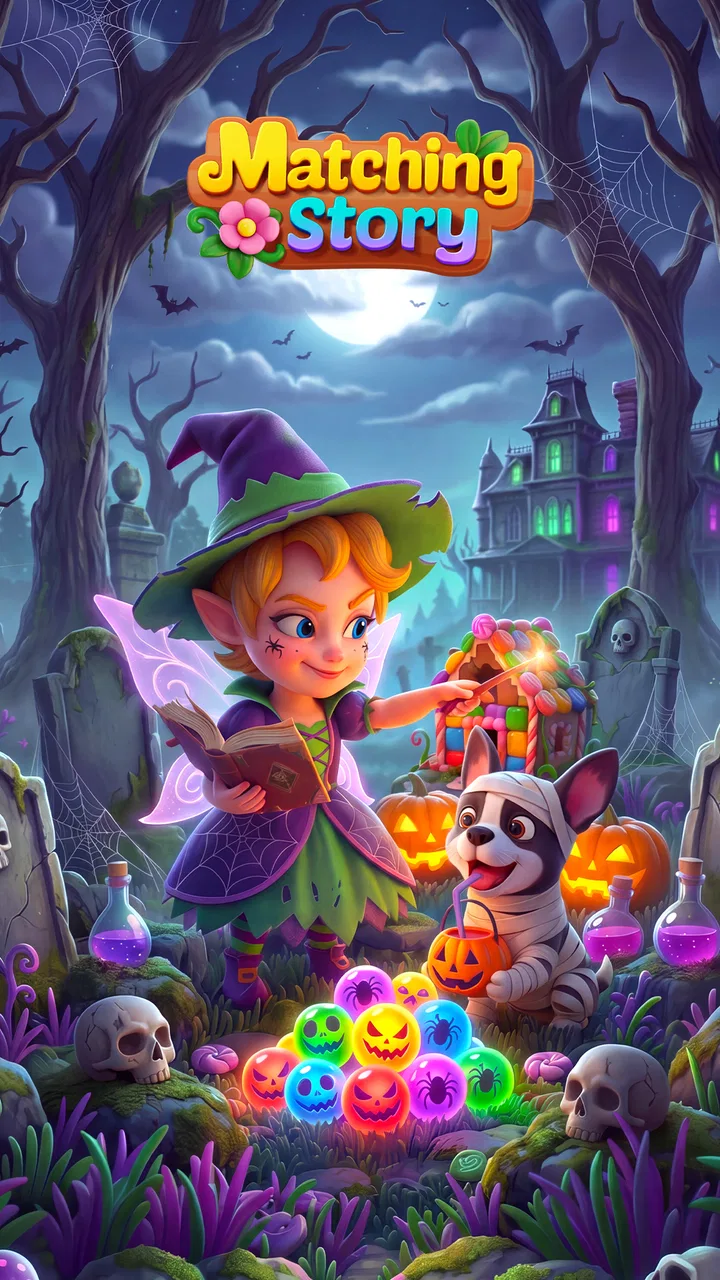
Some casual puzzle games ask for a few spare minutes, while others quietly become the game I return to whenever I want something gentle and colorful. Matching Story - Puzzle Games sits in that second group for me. It combines match-three boards with a collection of cute creatures and a place that gradually becomes your own paradise. The appeal is easy to understand from the first few moves, but the experience is more than simply swapping pieces until a level ends.
I found the game most enjoyable when I treated it as a relaxed routine rather than a challenge to rush through. A short session can fit into a coffee break, a commute, or the few minutes before bed. At the same time, the progression gives each completed puzzle a sense of purpose, because the matching is connected to collecting creatures and improving the surrounding world. The strongest part of Matching Story is the way a familiar puzzle format is tied to a personal, growing setting.
What the first session feels like
Matching Story is a casual game from VERTEX GAMES PTE. LTD., and it is free to download. Its age rating is Everyone, which matches the approachable presentation and simple premise. The game was released on August 23, 2023, and the current version is 1.59.02, with Android support starting at version 7.0. That makes it a practical option for people who do not use a recent phone, although the smoothness of any game can still depend on the individual device.
You May Also Like

 Google Keep - Notes and lists
Google Keep’s Quiet Growth Shows the Appeal of Simpler Notes
As mobile work gets busier, Google Keep keeps winning a simple contest: capture a thought quickly, find it later, and get on with the day.

 Blood Strike: 2.5 Anniversary
Blood Strike’s Loadouts Turn Every Drop Into a Tactical Gamble
A close look at Blood Strike’s custom loadouts: how fast access to signature weapons reshapes its battle royale rhythm, rewards preparation, and narrows the gap between fights.

 Pandora - Music & Podcasts
Pandora’s Music Is Easy to Start, but Harder to Recover
Pandora’s strength is its low-effort path from a seed to a station. Its weak spot is how much confidence it asks you to place in connection, setup, and quiet recovery.

 8 Ball Pool
 Is Built on Rivalries, Rematches, and Routine
A close look at the rivalries, rematches, shared routines, and unanswered safety questions that turn a quick pool match into a persistent mobile community.

 Samsung Music
’s Quiet Strength Is Playing What You Already Own
Its reach comes less from spectacle than from dependable access to a personal library. That simplicity is both the app’s strongest retention engine and its ceiling.

 AccuWeather: Weather Radar
AccuWeather Review: A Quick, Clear Forecast for Everyday Decisions
For everyday plans, the best forecast is the one you can understand quickly. AccuWeather makes rain timing, radar, and local conditions easy to act on, with a few trade-offs.
More From Our News Desk



The basic rhythm is familiar: look at the board, make matching moves, complete the objective, and use the result to continue building the game’s world. I did not need a long explanation before understanding what to do. The early design is clearly aimed at getting a new player into the action quickly rather than surrounding the first screen with complicated systems.
That simplicity is useful, but it also sets the right expectation. This is not a strategy game built around deep menus, a competitive ranking structure, or long sessions of planning. It is better understood as a light puzzle adventure with a decorative and collection-focused layer. If you want a demanding brain teaser where every move requires careful calculation, this may feel too forgiving. If you want something welcoming that still gives your progress a visible direction, it is much easier to recommend.
The store summary describes the central idea as blasting through match-three puzzles, collecting cute creatures, and building a paradise. I would not reduce the whole experience to that sentence, though. The important detail is the connection between those activities. The creatures and the setting give the puzzle boards context, while the boards provide the repeated activity that moves the larger journey forward.
The game has attracted a 4.9 average from around 304 thousand ratings, alongside roughly 9.9 thousand written reviews and more than 5 million installs. Those figures suggest that its friendly presentation and straightforward loop have reached a broad audience. I still recommend judging it by your own preferred pace, because a high overall rating does not change the fact that players who dislike repeated matching puzzles will eventually notice the repetition.
Getting through the first setup without overthinking it
When I start a game like this, I prefer to avoid spending time on every optional-looking screen before I understand the main loop. My advice is to move through the opening at a steady pace and pay attention to what the first puzzle actually asks you to accomplish. The goal is not merely to make any possible match. It is to notice the board objective and shape your moves around it.
This is the first useful habit to develop. A move that creates a larger clearing or removes a troublesome area can be more valuable than a move that looks attractive in isolation. Early levels are a good place to practice reading the whole board before touching anything. I found that taking a brief pause improved my results more than making quick swaps simply because they were available.
The visual style also makes the opening accessible to younger players and to anyone who does not normally play puzzle games. The Everyone rating supports that broad audience, but adults should not dismiss it as something only for children. The collection and building elements give the game enough structure to make repeated sessions feel purposeful, especially if you enjoy watching a setting develop gradually.
One practical point is the free-to-play structure. The game costs nothing to start, but it includes in-app purchases ranging from $0.99 to $99.99 per item. I recommend deciding before playing whether you want to keep the experience strictly free or whether you are comfortable considering optional purchases later. That small decision helps prevent the usual temptation to spend impulsively when a level takes longer than expected.
I also like to approach the opening as a learning stage rather than a test of skill. If a level does not go well, the useful question is not “Why am I bad at this?” but “Which objective did I ignore?” In match-three games, players often focus on making the biggest-looking combination while forgetting that the board may reward clearing a particular type of piece or reaching a specific condition. Reading the task first is a simple improvement that pays off immediately.
The first meaningful success
The first satisfying moment comes when a few deliberate moves produce a result that feels planned instead of accidental. I suggest looking for opportunities that affect several parts of the board at once. A move that opens space, advances the level objective, and creates a better follow-up is usually more useful than a move that only clears a small cluster.
This is where the game begins to feel less like tapping through instructions and more like a puzzle. I found it helpful to scan from the bottom upward before making a move, because changes lower on the board can alter what falls into place above. Even when the game remains relaxed, that small pause gives each turn a clearer purpose.
Another good beginner technique is to avoid using a helpful combination immediately if it can be saved for a more useful position. The best timing depends on the board, so I would not treat this as an absolute rule. Sometimes using a strong clearing move at once is the only way to open a blocked area. The broader lesson is to compare the immediate reward with the next two or three possible moves.
Once a puzzle is completed, the reward feels more meaningful because it feeds into the wider paradise-building and creature-collecting journey. That connection is what separates this experience from a plain match-three time filler. I enjoyed having a reason to care about the next board, even when the individual puzzle was not especially difficult.
For a realistic everyday example, imagine waiting for an appointment with only a few minutes available. I would open the game, complete part of a short session, and stop without feeling that I had abandoned a complicated campaign. Later, I could return to the same broader journey and continue. That low commitment is one of its best qualities for casual players who want progress without scheduling a long gaming session.
The same quality can work well for families. A parent can understand the controls quickly, while a child may be more interested in the creatures and the visual world. I would still recommend that adults manage purchases on the device, since the free entry point and optional items create a reason to keep an eye on spending even though the game is suitable for Everyone.
Where new players commonly get confused
The most likely confusion is assuming that every available match has equal value. It does not. A move can be valid and still be poor if it leaves the board crowded or fails to address the level’s actual requirement. I learned to stop chasing the most obvious match and instead check whether another move creates space or sets up a stronger chain.
Another source of friction is the balance between the puzzle itself and the surrounding collection and building progression. Players who only care about the fastest possible board completion may find the extra layer unnecessary. In contrast, players who enjoy decorating, collecting, or seeing gradual development may feel that the puzzle is a useful way to earn forward movement. Neither approach is wrong, but knowing which part interests you most will shape how rewarding the game feels.
The repetition is also worth acknowledging. The match-three foundation is approachable because it is familiar, but familiarity can become routine. I would not choose this game as my only puzzle title if I needed constant mechanical variety. It works better as a dependable comfort game, especially when I want colorful feedback and a clear objective instead of a difficult challenge.
There is also a difference between playing carefully and playing slowly. Careful play means checking the objective and looking for the move with the best wider effect. Slow play means hesitating over every harmless choice. The game is forgiving enough that I could usually make progress without treating each board like a tournament. That makes it suitable for relaxed sessions, but it may disappoint players who want every decision to carry serious consequences.
Purchases are another consideration. The free starting price is appealing, but the available items can cost from $0.99 up to $99.99 each. I would be especially cautious about buying something simply because I had become impatient with a difficult board. If you prefer a completely fixed-cost experience, a paid puzzle game with no purchase prompts may suit you better. If you are comfortable ignoring optional spending, the free entry point makes it easy to test the core loop first.
Compared with a traditional match-three game that focuses only on score or level completion, Matching Story gives me more emotional motivation through its creatures and paradise. Compared with a large simulation game, it is much lighter and easier to understand, but it also offers less room for complex planning. Compared with a pure decorating game, the puzzle boards are the main activity rather than a side task. That middle position is the game’s identity and also its main limitation.
How to make the next sessions more rewarding
After the first successful levels, I recommend choosing a personal rhythm. Some players will enjoy moving quickly through boards, while others will prefer to examine every possible combination. I found the best balance by playing with a simple priority order: first check the stated objective, then look for moves that open the board, and only afterward consider attractive matches that do not directly help.
That approach is particularly useful when the board begins to feel crowded. Clearing space early gives later pieces more room to create useful combinations. It also reduces the chance of spending several turns reacting to problems that could have been prevented. This is not a complicated advanced system, but it is the kind of small workflow that makes the game feel less random.
I also suggest separating collection goals from puzzle goals in your mind. The puzzle asks you to solve the immediate board, while the creatures and paradise provide longer-term motivation. If you focus too heavily on the final reward, an ordinary level can feel like a delay. If you focus only on the current board, the larger journey may lose its charm. Enjoying both layers keeps the pace comfortable.
The game is a good fit for someone who wants a gentle mobile activity, a colorful option for short breaks, or a casual title that can be understood without studying a manual. It is less suitable for someone seeking real-time competition, elaborate role-playing systems, or a puzzle format that changes dramatically from one session to the next. I would also point players who dislike free-to-play purchase structures toward a simpler paid alternative, even though the game itself can be started without paying.
Device compatibility is straightforward for Android users because the listed minimum is Android 7.0. The current version is 1.59.02, so I would check that an older phone has enough general storage and performs comfortably with modern games before settling in for regular play. I would not make a purchase decision based only on the minimum operating system; everyday performance matters more than the number on the settings screen.
The game’s large audience is understandable because it combines three approachable motivations: finish a board, discover or collect something appealing, and improve a place that feels personal. In my experience, that combination gives a basic puzzle loop more staying power than matching tiles alone. It also makes the game easy to recommend to a friend who wants something relaxing but still wants visible progress.
My final view is positive, with a clear qualification. Matching Story is at its best as a calm, progression-focused match-three game, not as a demanding puzzle laboratory. I like the accessible opening, the connection between successful boards and the growing paradise, and the way the creature collection gives short sessions a reason to continue. The repetitive foundation, free-to-play purchase range, and relatively gentle challenge will not suit everyone.
If you approach it as a friendly casual game rather than expecting endless novelty, it delivers a pleasant first-time experience and a comfortable reason to return. I would install it for relaxed breaks, family-friendly play, or a low-pressure collection journey. I would skip it only if my priority were deep strategy, competitive intensity, or a completely purchase-free design. For the audience it targets, the free starting point makes that decision easy: try the first few puzzles, learn to read the objectives, and see whether building this particular paradise gives the familiar matching formula enough personality for you.
Matching Story earns its place through that sense of gentle forward motion. It does not need to reinvent match-three puzzles to be enjoyable. Instead, it gives each board a small role in a broader journey, and that is enough to turn a few spare minutes into a satisfying routine.
FAQs for Matching Story - Puzzle Games
01What is Matching Story - Puzzle Games about?
Matching Story - Puzzle Games is a captivating puzzle game that combines match-3 mechanics with a narrative-driven adventure. Players solve puzzles to progress through various levels, unlocking new story elements and characters. The game appeals to those who enjoy both engaging storytelling and strategic puzzle-solving.
02Is Matching Story - Puzzle Games free to play?
Yes, Matching Story - Puzzle Games is free to download and play on both Android and iOS platforms. However, the game includes in-app purchases and optional ads, which can enhance gameplay or provide additional content. Players can enjoy the core experience without spending money, but purchases can speed up progress.
03What are the main features of Matching Story - Puzzle Games?
The game offers a mix of challenging match-3 puzzles and an intriguing storyline. Players can expect beautifully designed levels, diverse characters, and regular updates with new content. The app also includes various power-ups and boosters that assist players in overcoming difficult challenges, enriching the overall gameplay experience.
04Does Matching Story - Puzzle Games require an internet connection?
While Matching Story - Puzzle Games can be played offline, an internet connection is recommended to access all features. Certain elements, such as daily challenges, leaderboards, and event participation, require connectivity. Additionally, being online allows players to receive updates and new content seamlessly.
05Are there any tips for progressing in Matching Story - Puzzle Games?
To progress effectively, focus on mastering the use of power-ups and boosters. Pay attention to level objectives, and try to make strategic matches that align with these goals. Regularly participating in events and challenges can also provide extra rewards and help players advance faster in the game.
Pros
- Engaging storyline enhances puzzle experience.
- Variety of levels keeps gameplay fresh.
- Visually appealing graphics and animations.
- Easy to learn for beginners.
- Frequent updates with new challenges.
Cons
- Requires internet connection to play.
- In-app purchases can be expensive.
- Occasional ads interrupt gameplay.
- Some puzzles can feel repetitive.
- Limited offline features.

Matching Story - Puzzle Games
Gallery